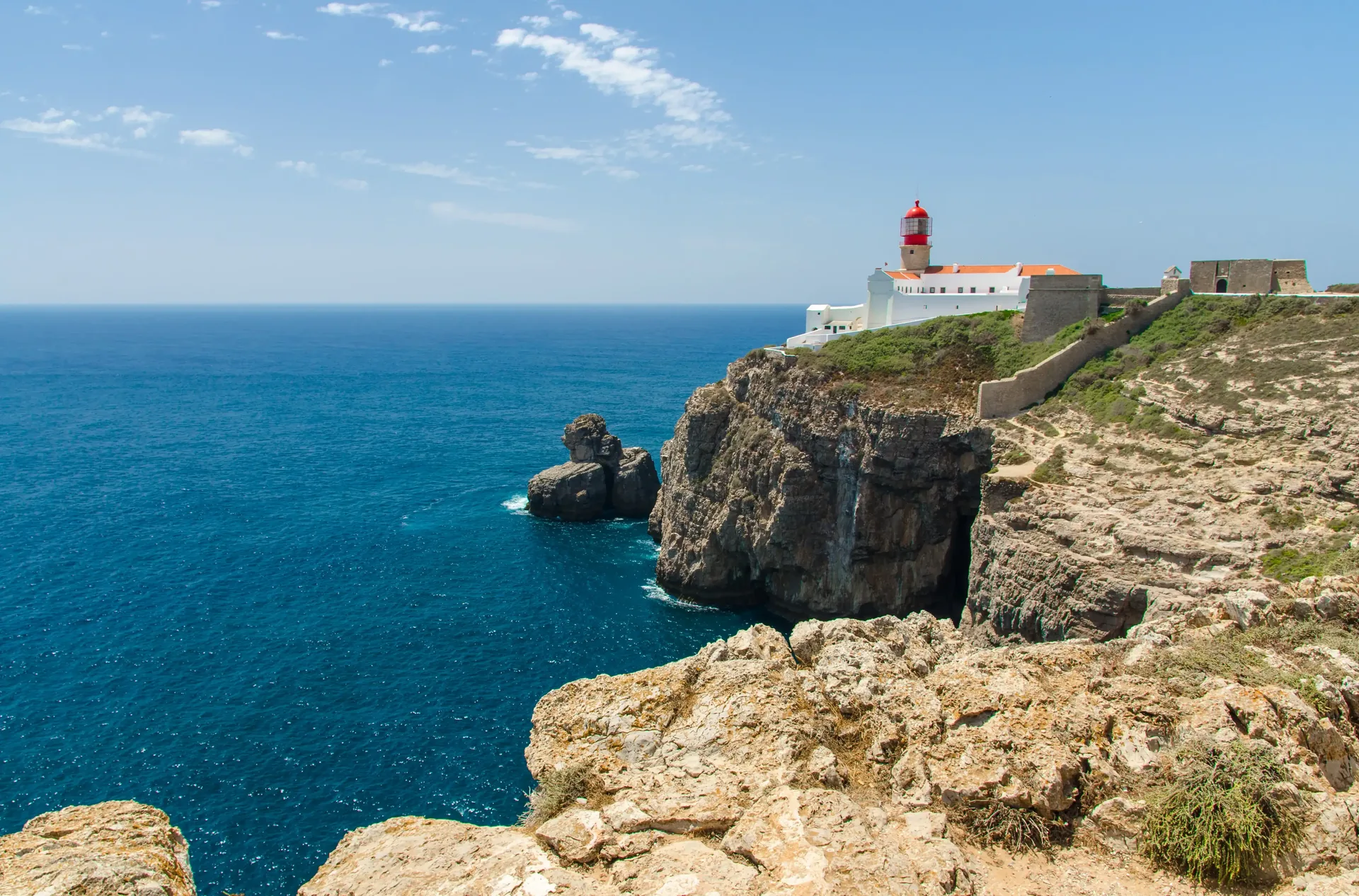
There is a point on the southwestern tip of Europe where the land simply stops. Not gradually, not politely — it stops without warning at the edge of 75-metre cliffs, with nothing between you and North America but 6,000 kilometres of open Atlantic. This is Cabo de São Vicente, and the small town of Sagres sits just behind it, carrying the weight of one of history's great stories.
This is where Prince Henry the Navigator gathered the cartographers, astronomers and sea captains who would send Portuguese ships into the unknown and change the map of the world. The fortress walls still stand. The wind still blows — relentlessly — off the ocean. And the light in the late afternoon, when it falls across the cliffs, is unlike anything else in Portugal.
Sagres is the Algarve at its most raw. No golf resorts, no waterparks, no strip of beach bars. Just the end of the world, which turns out to be a remarkably good place to spend a few days.
Why Sagres Feels Different from the Rest of the Algarve
The Algarve is Portugal's most-visited region, and much of its coastline reflects that — polished, comfortable, built to welcome millions of tourists each year. Sagres is the exception. It sits at the far western end of the coast, past Lagos, past the last roundabout, at the end of a road that goes nowhere after it.
The result is a town that still feels genuinely local. A single high street, a handful of restaurants, surf schools that cater to people who came for the waves and stayed for months. The surrounding landscape — scrubby heath, red-clay cliffs, wind-bent pines — belongs to the Parque Natural do Sudoeste Alentejano e Costa Vicentina, one of Europe's most rigorously protected coastal areas. That designation prevents the development that has transformed much of the Algarve, which is exactly why Sagres looks the way it does.
Sagres Fortress — Where the Age of Discovery Began
The Fortaleza de Sagres is built on a dramatic promontory — a flat-topped headland dropping sheer to the sea on three sides, connected to the mainland by a narrow neck of land. Prince Henry the Navigator established his school of navigation here in the 15th century, recruiting the finest minds in Europe to solve the problems of deep-ocean sailing: how to measure latitude at sea, how to build ships that could sail against the wind, how to chart coasts no European had ever seen.
The most extraordinary object inside the fortress is the Rosa dos Ventos — a giant wind compass laid in stone on the ground, 43 metres in diameter. Its exact age is debated; some historians believe it dates from Henry's time, others argue it is later. Standing at the centre of it, with the ocean visible on three sides and the wind pressing against you, is one of those genuinely moving experiences that travel occasionally delivers.
The fortress church, the cistern, the simple stone walls — none of it is elaborate. The power of this place is entirely in its setting and its story: the idea that from this bare, windswept headland, the Portuguese sailed to Brazil, to Africa, to India, to Japan. That all of it began here.
Cabo de São Vicente — The End of the World
Six kilometres north of Sagres, the road ends at a lighthouse perched on the most southwesterly point of continental Europe. The cliffs of Cabo de São Vicente are among the most dramatic on the continent — sheer faces of dark rock, weathered into strange formations by millions of years of Atlantic storms, plunging to the sea below.
The Romans called this point Promontorium Sacrum — the Sacred Promontory — and it is easy to understand why. There is something genuinely elemental about standing here. The ocean stretches to the horizon in three directions. On a clear day you can feel the curve of the Earth. If you arrive at sunset, which you absolutely should, the light turns the stone cliffs rust-orange, the sea below goes from deep blue to black, and you will understand immediately why sailors through history both feared and revered this place.
Around the car park, vendors sell warm blankets, grilled corn and cold Sagres beer — an informal economy that has been operating at this spot for decades. Buy something. You'll want the blanket if you stay for the sunset. The lighthouse opens for guided visits on weekends; the beam is visible up to 32 nautical miles out to sea, one of Europe's most powerful.
The Beaches Around Sagres
The beaches around Sagres are among the finest in the Algarve — wilder, less crowded and more dramatic than the sheltered cove beaches of the eastern coast. They face the open Atlantic, which means proper waves, stronger currents and water that runs slightly cooler even in peak summer. Come here for beach walking, surfing and swimming with real ocean energy — not for the calm flat water of Meia Praia or Quinta do Lago.
Praia da Mareta
The town beach, right in front of the main square. Sheltered by the headland on one side, it offers safe swimming by the standards of this Atlantic coast. There is a decent beach bar, and the backdrop of ochre cliffs makes it one of the more photogenic beaches in the western Algarve. Busy in August, but never unpleasantly so — Sagres does not attract the bus-tour crowds of Lagos.
Praia do Tonel
The surfers' beach, on the other side of the Sagres headland from Mareta. Larger, more exposed, and consistently good surf with a sandy bottom suitable for beginners in summer and experienced riders in winter. The clifftop access road gives dramatic views before you descend. When the swell is up in winter, this is one of the better spectator spots in southern Portugal.
Praia do Beliche
A dramatic, narrow cove tucked between Sagres and Cabo de São Vicente — steep access, a small crescent of sand hemmed in by cliffs, and turquoise water that can be exceptional on a calm day. Not suitable for swimming when there is swell, but spectacular when conditions allow. Often quieter than the other beaches precisely because the walk down discourages casual visitors.
Praia do Martinhal
To the east of Sagres, slightly more sheltered and popular with families and windsurfers. A long sweep of sand with the Martinhal resort behind it — the one concession to upscale tourism in the area. The beach itself is open and free to all.
Surfing & Water Sports in Sagres
Sagres is one of Portugal's premier surf destinations, drawing riders from across Europe who come for the quality and consistency of the breaks. The western Algarve coast picks up Atlantic swell from multiple directions, which means that when Praia do Tonel is blown out, Martinhal may be perfect — and there is almost always somewhere rideable within a short drive.
In summer (June–September), the waves are generally more manageable: chest-to-head high at the main beaches, with clean conditions on many mornings before the afternoon wind picks up. The surf schools in the town run beginner and intermediate lessons throughout the season — several are run by long-term residents who know every break intimately. In winter, the swell increases significantly. Some days at Beliche and Tonel, waves reach 3–4 metres; this is when the experienced Europeans arrive and Sagres takes on the feel of a committed surf pilgrimage.
Beyond surfing, the area also supports stand-up paddleboarding (on the calmer days at Martinhal), kayaking along the cliffs, coasteering, and guided snorkelling in the crystal-clear waters of Beliche cove. The Rota Vicentina — a long-distance walking trail along the Costa Vicentina — passes through the area and offers some of Portugal's finest coastal hiking if you want to explore on foot.
Where to Eat & Drink in Sagres
Sagres has a compact but surprisingly good restaurant scene — modest in number but punching well above its weight for a town this size. The signature ingredient is atum (Atlantic bluefin tuna), caught locally and served in everything from thick grilled steaks to thin carpaccio to hearty rice dishes. If you eat only one thing in Sagres, make it the fresh tuna. If you eat two things, follow it with cataplana — the Algarve's traditional clay-pot seafood stew, slow-cooked with clams, prawns and white wine.
Restaurante O Telheiro do Infante
Often called simply "A Sagres" by locals — the most-recommended fish restaurant in town, right on the main square. A no-nonsense room with efficient service, exceptional grilled fish (sea bream, sole, dourada) and the best cataplana in the area. Arrive before 7:30pm or expect a wait in summer.
Dromedário Café
A cafe-restaurant beloved by the local surf community. Good for breakfast and light lunches; generous portions, reasonable prices, friendly staff who have probably been there since the place opened. The kind of spot you end up returning to every morning of a Sagres stay.
Raposo
A reliable option for grilled meat and fish on a terrace with evening breezes. Less exclusively fish-focused than Telheiro, which makes it useful if your group has non-seafood eaters. The house bread and local olive oil that arrives at the table unprompted is worth ordering the rest of the meal around.
Sunset at Cabo de São Vicente
There are no formal bars at the Cape. The vendors around the car park sell local beer, wine, hot drinks and blankets. This improvised sunset ritual — standing at the edge of Europe with a cold Sagres beer as the Atlantic sky turns orange — has become something of an institution among visitors. Don't miss it, and don't rush away when the sun drops. The light stays beautiful for another 20 minutes.
Getting to Sagres & Getting Around
By car is comfortably the best way to reach and explore Sagres. From Lagos, take the EN125 west and then the EN268 — a straightforward 45-minute drive with clear signage throughout. From Faro airport, allow 1 hour 45 minutes. From Lisbon, it is about 3 hours on the A2 motorway and then the EN125 across the Algarve. Car hire at Faro airport is well-priced and opens up the entire western Algarve.
By bus, Eva Transportes runs services from Lagos to Sagres (approximately 1 hour, around €5 each way). The service is limited — typically 4–6 departures per day — so check the timetable before you rely on it. There is no direct bus from Faro or the eastern Algarve to Sagres.
Getting to Cabo de São Vicente from Sagres: a car is essential. The cape is 6 kilometres from the town centre along a road with no footpath or cycling lane. There is no shuttle or local bus. The drive takes less than 10 minutes. Taxis are available in Sagres but should be booked in advance, especially for the sunset run.
When to Go & How Long to Stay
Sagres in July and August is warm, reliably dry, surf-friendly and pleasantly busy — peak season, but the town never becomes overwhelming because there simply isn't the resort infrastructure to support mass tourism. In May, June and September, the conditions are excellent and the crowds thinner: this is arguably the best time to come, when the beaches are quieter, the restaurants easier, and the Atlantic light at its most beautiful. In October through April, the serious surfers arrive, the town quietens dramatically, and the landscape takes on a moody, end-of-the-world quality that some travellers find even more compelling than the summer version.
| Season | Conditions | Best For | Crowds |
|---|---|---|---|
| May–Jun | Warm, quieter, good surf | First-timers, couples, hikers | Low |
| Jul–Aug | Peak summer, warmest | Families, beach swimming | Moderate |
| Sep–Oct | Warm, swell building | Surfers, walkers, photographers | Low |
| Nov–Mar | Wild, dramatic, big waves | Experienced surfers, solitude | Very low |
How long to stay: Sagres rewards at least two nights. One full day gives you the Fortaleza, the Cape and a proper beach afternoon. A second day lets you explore the beaches in more depth, try a surf lesson or coastal walk, eat dinner slowly without rushing to catch a drive back, and actually feel the rhythm of the place. Visitors who rush through in a single afternoon almost always say the same thing: they should have stayed.
Explore the Algarve with a Private Guide
Our private Algarve tours cover Sagres, Lagos, the hidden beaches and the interior — tailored exactly to how you want to travel.